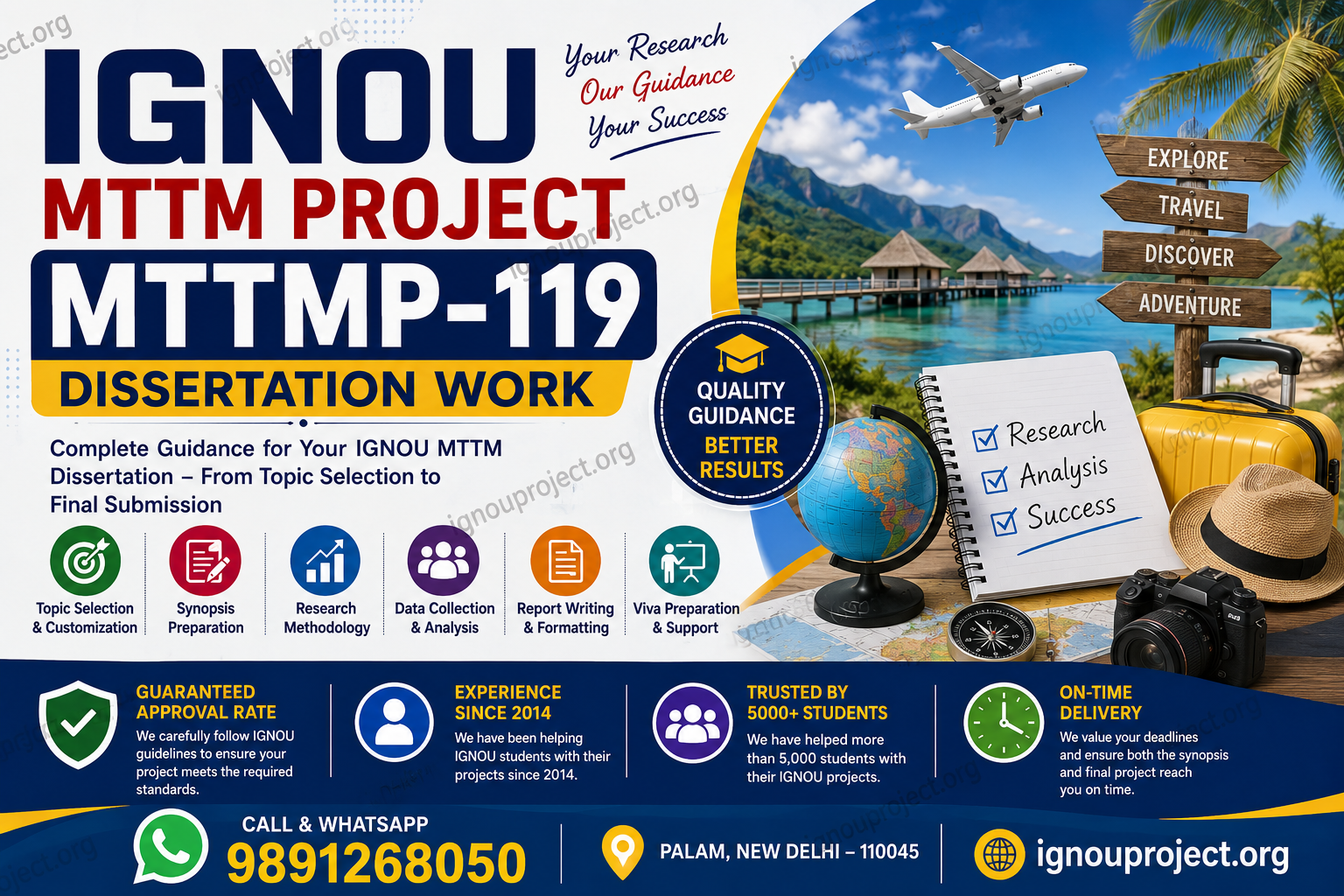
IGNOU MTTM Project MTTMP-119: Topics, Synopsis and Dissertation Guidance
Are you pursuing the Master of Tourism and Travel Management (MTTM) programme from IGNOU and finding it difficult to prepare your IGNOU MTTM Project MTTMP-119? You are not alone. Many students face difficulties in selecting an appropriate tourism research topic, preparing the project synopsis, choosing a suitable research methodology, collecting data and organising the final dissertation in the required academic format.
The MTTMP-119 Dissertation Work provides students with an opportunity to conduct independent research on a practical issue related to tourism, travel or hospitality. It allows learners to apply their theoretical understanding, research knowledge and analytical skills to real-world tourism problems.
Students may conduct research on subjects such as sustainable tourism, destination management, tourist behaviour, heritage conservation, hospitality services, rural tourism, digital tourism marketing, travel technology and tourism entrepreneurship.
For guidance related to the IGNOU MTTM Project MTTMP-119, contact us:
Call and WhatsApp: 9891268050
Location: Palam, New Delhi – 110045
IGNOU MTTM Project MTTMP-119 – Course Overview
MTTMP-119 is officially titled Dissertation Work in the revised IGNOU Master of Tourism and Travel Management programme. It is an eight-credit project course included in the fourth semester. The course aims to strengthen the research competencies of learners by providing practical exposure to the tourism and hospitality sector through independent research.
The revised MTTM programme is a two-year postgraduate degree consisting of four semesters. IGNOU introduced the revised programme structure, identified as MTTM_NEW, for learners admitted from the July 2026 session. Students admitted under an earlier MTTM structure should verify their applicable dissertation code before beginning the project.
The dissertation requires students to identify a tourism-related research problem, formulate objectives, review relevant literature, select an appropriate methodology, collect and analyse data and present meaningful conclusions.
Why the IGNOU MTTM Project MTTMP-119 Matters
The IGNOU MTTM dissertation is not merely a descriptive report about a tourist place. It is a systematic academic investigation through which students demonstrate their ability to understand and analyse a practical tourism or hospitality problem.
Tourism is closely connected with transportation, accommodation, food services, cultural heritage, local employment, entrepreneurship, environmental conservation and destination development. Through MTTMP-119, learners can examine how these sectors operate and how tourism influences visitors, businesses, communities and destinations.
Completing the dissertation helps students develop important academic and professional abilities, including:
- Identifying a tourism or hospitality research problem
- Formulating appropriate research objectives
- Reviewing previous studies and reports
- Selecting suitable research methods
- Preparing questionnaires and interview schedules
- Collecting primary and secondary data
- Organising information through tables and charts
- Interpreting tourist and stakeholder responses
- Preparing evidence-based findings and recommendations
- Presenting research in a structured academic format
A well-prepared project can also strengthen the learner’s academic profile and improve readiness for careers in tourism management, hospitality, travel operations, destination marketing, entrepreneurship and research.
20 IGNOU MTTM Project Topics for MTTMP-119
Selecting a relevant and manageable topic is the first major step in preparing the MTTMP-119 dissertation. The topic should be related to tourism or hospitality, supported by accessible data and possible to complete within the available time.
The following are 20 suggested IGNOU MTTM project topics:
- Impact of Social Media Marketing on Tourist Destination Selection
- Tourist Satisfaction with Heritage Tourism Services in Delhi
- Role of Digital Marketing in Promoting Domestic Tourism
- Impact of Online Travel Agencies on Tourist Booking Behaviour
- A Study of Sustainable Tourism Practices at Selected Tourist Destinations
- Role of Local Communities in the Development of Rural Tourism
- Impact of Religious Tourism on the Local Economy
- Tourist Perception of Safety and Security at Tourist Destinations
- Role of Homestays in Promoting Community-Based Tourism
- Impact of Tourism Development on Local Employment Generation
- Customer Satisfaction with Hotel Services in New Delhi
- Role of Cultural Festivals in Destination Promotion
- Impact of Online Reviews on Hotel-Selection Decisions
- Assessment of Waste-Management Practices at Tourist Destinations
- Growth and Potential of Medical and Wellness Tourism in India
- Role of Travel Influencers in Shaping Tourist Behaviour
- Women’s Participation in Tourism and Hospitality Entrepreneurship
- Challenges of Accessible Tourism for Persons with Disabilities
- Impact of Climate Change on Tourism Destination Management
- Use of Artificial Intelligence and Smart Technology in Tourism Services
These topics are samples. The final project title may be customised according to the learner’s interests, geographical area, professional experience, availability of respondents and accessibility of reliable data.
Popular Research Areas for MTTMP-119
Students can select their dissertation topic from several emerging and traditional areas of tourism research.
Sustainable and Responsible Tourism
Research may focus on environmental conservation, carrying capacity, waste management, community participation, responsible tourist behaviour, eco-friendly accommodation and sustainable destination development.
Heritage and Cultural Tourism
Students may examine heritage conservation, monuments, museums, traditional festivals, handicrafts, culinary traditions, cultural authenticity and visitor experiences.
Hospitality Management
Projects may address hotel service quality, guest satisfaction, customer loyalty, online reviews, employee motivation, food-waste reduction, revenue management and technology adoption.
Destination Management
Students can study destination branding, infrastructure, visitor management, stakeholder coordination, safety, crisis management and destination competitiveness.
Digital Tourism
Research topics may include social media marketing, online travel agencies, digital booking behaviour, travel applications, virtual tourism, artificial intelligence and online reputation management.
Rural and Community-Based Tourism
Projects may examine homestays, local entrepreneurship, women’s participation, community ownership, employment generation and the preservation of local traditions.
Special-Interest Tourism
Students may select subjects related to adventure tourism, medical tourism, wellness tourism, religious tourism, wildlife tourism, culinary tourism, dark tourism or educational tourism.
Tourism Entrepreneurship
Research may focus on tourism start-ups, innovative travel services, local guides, small hospitality businesses, homestay enterprises and women-led tourism ventures.
How to Select the Best MTTMP-119 Project Topic
A good research topic should be focused, relevant and feasible. A very broad title such as “Tourism Development in India” may be difficult to investigate within a student dissertation.
The topic can be made more specific by identifying a particular location, organisation, tourist group or tourism service. For example:
Broad topic: Heritage Tourism in India
Focused topic: Tourist Satisfaction with Heritage Tourism Facilities at Selected Monuments in Delhi
Similarly:
Broad topic: Social Media and Tourism
Focused topic: Impact of Instagram Travel Content on Destination Selection Among College Students in Delhi
A suitable MTTMP-119 topic should meet the following conditions:
- It should be directly related to tourism, travel or hospitality.
- It should address a clearly identifiable research problem.
- Required respondents or secondary data should be accessible.
- The study should be manageable within the available time.
- The objectives should be specific and measurable.
- The geographical area should be clearly defined.
- The methodology should be appropriate for the topic.
- The research should have academic or practical importance.
Students should also select a topic they can understand and explain confidently during the project evaluation or viva.
Sample Location-Based MTTMP-119 Project Titles
Students who prefer to conduct research in Delhi or nearby areas may consider the following titles:
- A Study of Tourist Satisfaction at India Gate, New Delhi
- Tourist Perception of Safety at Selected Attractions in Delhi
- Role of Social Media in Promoting Heritage Tourism in Delhi
- Impact of Online Reviews on Hotel Selection Among Tourists Visiting Delhi
- Customer Satisfaction with Budget Hotels Near Delhi Airport
- Contribution of Street-Food Tourism to the Visitor Experience in Old Delhi
- Tourist Satisfaction with Facilities at Qutub Minar
- Visitor Perception of Cleanliness at Selected Heritage Sites in Delhi
- Role of Local Guides in Improving Tourist Experiences in Delhi
- Impact of Metro Connectivity on Tourism Development in Delhi
IGNOU MTTMP-119 Synopsis Preparation
The project synopsis or research proposal provides a plan for the proposed dissertation. It explains what the learner intends to study, why the research is important and how the study will be conducted.
The synopsis should maintain a logical connection between the project title, research problem, objectives, data-collection methods and proposed analysis.
A properly organised MTTMP-119 synopsis may include the following sections.
Proposed Project Title
The title should clearly communicate the subject, target population and geographical area of the proposed research.
Introduction and Background
This section introduces the selected tourism issue and explains its broader academic or practical context.
Statement of the Problem
The statement of the problem identifies the specific issue that the researcher intends to examine.
Rationale of the Study
The rationale explains why the research is important for tourists, tourism businesses, local communities, destination managers or policymakers.
Review of Literature
The literature review briefly examines previous books, journal articles, research papers, reports and other reliable sources related to the selected topic.
Objectives of the Study
The objectives should clearly state what the researcher intends to investigate. They should be specific, practical and directly connected with the project title.
Research Questions or Hypotheses
Research questions identify the issues that the study will attempt to answer. Hypotheses may be developed where the research requires statistical testing.
Research Methodology
The methodology generally explains:
- Research design
- Study area
- Population of the study
- Sample size
- Sampling method
- Sources of primary and secondary data
- Data-collection tools
- Methods of data analysis
- Limitations of the study
Proposed Chapter Scheme
The synopsis may provide a tentative chapter-wise organisation of the final dissertation.
Bibliography or References
All sources consulted during synopsis preparation should be properly acknowledged.
Sample Research Objectives for MTTMP-119
Suppose the selected topic is:
“Impact of Online Reviews on Hotel Selection Among Tourists Visiting Delhi.”
The research objectives may be written as follows:
- To identify the online platforms commonly used by tourists for reading hotel reviews.
- To examine the influence of online ratings on hotel-selection decisions.
- To study the importance of review credibility, customer photographs and written feedback.
- To analyse the major difficulties tourists experience while relying on online hotel reviews.
- To suggest measures for improving the online reputation of hotels.
The questionnaire, data analysis, findings and conclusion should be directly connected with these objectives.
Research Methodology for the IGNOU MTTM Project
Research methodology explains the systematic process through which the project will be completed.
Research Design
Depending on the nature of the topic, the student may use a descriptive, exploratory, analytical, comparative or case-study research design.
Primary Data
Primary data is collected directly from respondents. In tourism research, respondents may include:
- Domestic or international tourists
- Hotel guests
- Hotel employees
- Travel agents
- Tour operators
- Local residents
- Tourism entrepreneurs
- Destination managers
- Tour guides
Primary data may be collected through questionnaires, interviews, observations, online surveys or focus-group discussions.
Secondary Data
Secondary data may be collected from:
- Books and research journals
- Tourism reports
- Government publications
- Institutional reports
- Destination-management documents
- Hotel or travel-company records
- Reliable statistical databases
- Credible online sources
Sampling Method
When it is not possible to study the entire population, a sample is selected. Common sampling methods include simple random sampling, convenience sampling, purposive sampling, stratified sampling and snowball sampling.
The selected sampling method should be suitable for the nature of the respondents and the practical conditions of the field survey.
Data Analysis
Depending on the project objectives, data may be analysed using:
- Frequency distribution
- Percentages
- Mean scores
- Ranking methods
- Cross-tabulation
- Satisfaction scales
- Correlation
- Comparative analysis
- Thematic interpretation
Tables, graphs and charts should be used wherever they improve the clarity of the analysis. Every table should be followed by a meaningful interpretation.
Recommended Structure of the MTTMP-119 Dissertation Report
A properly organised structure improves the readability and academic quality of the final project report.
Title Page
The title page should contain:
- Title of the dissertation
- Name of the student
- Enrolment number
- Programme code
- Course code: MTTMP-119
- Study Centre
- Regional Centre
- Academic session
- Name of the university
Certificate
The certificate authenticates the completion of the dissertation under the supervision of the approved project guide, wherever applicable.
Student Declaration
The declaration confirms that the submitted dissertation is the student’s original academic work and has not been submitted earlier for another qualification.
Acknowledgement
The student may acknowledge the support received from the supervisor, respondents, organisations, teachers, friends and family members.
Table of Contents
The table of contents should present chapter titles, headings, subheadings and corresponding page numbers.
List of Tables and Figures
Separate lists may be provided when the dissertation contains several tables, graphs, photographs or figures.
Chapter 1: Introduction
This chapter may include:
- Background of the study
- Statement of the problem
- Rationale of the study
- Research objectives
- Research questions or hypotheses
- Scope of the study
- Limitations of the study
Chapter 2: Review of Literature
This chapter reviews previous studies related to the selected subject and identifies the research gap addressed by the dissertation.
Chapter 3: Research Methodology
This chapter explains the research design, study area, population, sample size, sampling method, data sources, data-collection tools and methods of analysis.
Chapter 4: Profile of the Study Area or Organisation
This chapter presents relevant information about the destination, hotel, travel company, community or organisation selected for the study.
Chapter 5: Data Analysis and Interpretation
The collected data is presented through tables, graphs, percentages, rankings or thematic categories. Each result should be interpreted clearly.
Chapter 6: Major Findings and Discussion
The principal findings are summarised and discussed in relation to the research objectives and previous studies.
Chapter 7: Conclusion and Suggestions
This chapter presents the overall conclusion, practical recommendations, research limitations and possible areas for future study.
Bibliography or References
All books, research articles, reports, websites and other sources used in the project should be properly acknowledged.
Appendices
Appendices may contain:
- Questionnaire
- Interview schedule
- Consent form
- Photographs
- Maps
- Additional tables
- Supporting documents
Why Students May Need Guidance for MTTMP-119
Preparing a postgraduate tourism dissertation requires academic knowledge, research skills and practical understanding of the tourism industry. Many distance-learning students manage employment, family responsibilities and academic work simultaneously.
Students commonly experience difficulties such as:
- Confusion regarding project requirements
- Difficulty selecting a feasible topic
- Lack of clarity about the synopsis format
- Problems defining research objectives
- Limited knowledge of research methodology
- Difficulty preparing a questionnaire
- Challenges in collecting field data
- Errors in tables and interpretations
- Weak connections between objectives and findings
- Incorrect referencing and formatting
- Lack of confidence before the viva
- Difficulty completing the project within the deadline
Systematic academic guidance can make the project process more organised, understandable and manageable.
Why Choose Us for IGNOU MTTM Project MTTMP-119?
Choosing suitable academic guidance can help students avoid common mistakes and prepare their dissertation more confidently. We provide structured and student-friendly assistance for different stages of the MTTMP-119 project.
Approval-Focused Project Guidance
We carefully review the major components of the synopsis and final dissertation according to the applicable project instructions. The title, objectives, methodology, questionnaire, chapter structure, references and formatting are checked to reduce errors that may result in corrections or rejection.
No independent service can guarantee approval because the final decision remains with IGNOU, the approved supervisor and the evaluator. However, our detailed review process is focused on preparing a properly structured and academically consistent project.
Experience Since 2014
We have been assisting IGNOU students with project guidance since 2014. This experience has helped us understand the common difficulties faced by distance-learning students and the characteristics of a well-organised academic project.
Our guidance focuses on maintaining a logical relationship between the research problem, objectives, methodology, analysis, findings and conclusion.
Trusted by More Than 5,000 Students
More than 5,000 students have received assistance with different stages of their IGNOU projects. This experience enables us to provide practical guidance across different subjects, project formats and research requirements.
Every project is approached according to the student’s selected topic, study area, academic needs and availability of data.
On-Time Delivery
We understand the importance of submission deadlines. The synopsis, questionnaire, chapters, corrections and final project report are planned carefully to support timely completion.
Students are advised to begin early so that adequate time remains for topic selection, approval, data collection, revision and final formatting.
Personalised Topic Selection
We do not recommend one general topic to every learner. The project topic can be customised according to the student’s location, professional background, research interests and accessibility of respondents.
Chapter-Wise Guidance
The dissertation is organised systematically so that every chapter remains connected with the research objectives and methodology.
Research Methodology Support
Students receive assistance in understanding research design, sample size, sampling techniques, data sources, questionnaire preparation and analytical methods.
Data-Analysis Assistance
Support is available for organising survey responses, preparing tables and charts and writing clear interpretations based on the collected data.
Clear and Student-Friendly Language
The project is prepared and explained in clear academic language so that students can understand their research and confidently discuss it during evaluation or viva.
Topic-Specific and Originality-Focused Work
The project content is developed according to the selected topic, research area and available data. Students are encouraged to participate actively, verify all information and understand the complete project before submission.
Revision and Correction Support
Existing synopses and dissertations can be reviewed for academic structure, language, methodology, consistency, referencing and formatting.
Our IGNOU MTTM Project Support Services
We provide comprehensive guidance for the IGNOU MTTM Project MTTMP-119, including:
- Project-topic selection and customisation
- Synopsis and research-proposal preparation
- Formulation of research objectives
- Development of research questions or hypotheses
- Research methodology and sampling guidance
- Questionnaire and interview-schedule preparation
- Primary and secondary data guidance
- Data classification and analysis
- Preparation of tables, graphs and charts
- Chapter-wise dissertation assistance
- Findings, conclusion and suggestions
- Bibliography and referencing support
- Editing, proofreading and formatting
- Review and correction of existing projects
- Viva and presentation preparation
Step-by-Step Process for MTTMP-119 Project Guidance
Step 1: Contact Us
Share your programme name, course code, admission session and preferred research area through call or WhatsApp.
Step 2: Verify the Applicable Course Code
Confirm that MTTMP-119 applies to your admission session and programme structure.
Step 3: Select a Suitable Topic
Choose a focused and researchable topic according to your interests, location and availability of data.
Step 4: Prepare the Synopsis
Develop the title, introduction, research problem, objectives, literature review, methodology and proposed chapter plan.
Step 5: Complete the Applicable Approval Process
Submit the synopsis and follow the instructions provided by IGNOU, the Study Centre and the approved project supervisor.
Step 6: Collect the Required Data
Conduct questionnaires, interviews, observations or secondary-data collection according to the approved methodology.
Step 7: Analyse the Data
Organise and interpret the collected information in relation to the research objectives.
Step 8: Prepare the Dissertation
Write the project chapter by chapter with proper tables, findings, references and conclusions.
Step 9: Review and Format the Report
Check the project for academic consistency, grammar, page arrangement, citations and overall presentation.
Step 10: Prepare for the Viva
Understand the research problem, methodology, sample, major findings, limitations and recommendations.
Who Can Contact Us?
Our MTTMP-119 guidance is suitable for:
- Students who need help selecting a tourism project topic
- Learners preparing their first project synopsis
- Students whose synopsis requires revision
- Learners confused about research methodology
- Students requiring questionnaire preparation
- Learners needing assistance with data analysis
- Students who have collected data but need help organising it
- Learners requiring editing and formatting support
- Students preparing for dissertation viva
- Working learners facing time-management difficulties
Start Your IGNOU MTTM Project with Confidence
The IGNOU MTTM Project MTTMP-119 provides an opportunity to transform academic learning into practical tourism research. A meaningful dissertation can contribute to a better understanding of tourists, destinations, hospitality organisations, local communities and emerging developments in the tourism sector.
The quality of the project depends on selecting an appropriate topic, developing clear objectives, applying a suitable methodology and interpreting evidence carefully. With a systematic approach and active student participation, MTTMP-119 can become a valuable component of your postgraduate academic journey.
Contact Us Today
For assistance with IGNOU MTTM Project MTTMP-119 topic selection, synopsis, questionnaire, research methodology, data analysis, dissertation writing, formatting and viva preparation, contact us today.
Call and WhatsApp: 9891268050
Location: Palam, New Delhi – 110045
Website: ignouproject.org
Get systematic, personalised and student-friendly guidance for your IGNOU Master of Tourism and Travel Management Dissertation Work – MTTMP-119.
Important Academic Disclaimer
We are an independent academic-support provider and are not an official department, study centre or authorised representative of IGNOU.
Our services are intended for research guidance, mentoring, editing and formatting support. Students should participate actively in the research process, understand their project, verify all information and follow the latest instructions issued by IGNOU, their Regional Centre, Study Centre and approved project supervisor.
Frequently Asked Questions
What is MTTMP-119?
MTTMP-119 is titled Dissertation Work in the revised IGNOU Master of Tourism and Travel Management programme. It is an eight-credit project course placed in the fourth semester.
Is MTTMP-119 applicable to all MTTM students?
MTTMP-119 forms part of the revised MTTM_NEW structure introduced from the July 2026 admission session. Students admitted under an earlier structure should verify their applicable dissertation code from their registration details and programme guide.
Can I get assistance in selecting a project topic?
Yes. Topic-selection guidance is available according to the student’s interests, study location, professional background and availability of data.
Do you provide support for synopsis preparation?
Yes. Guidance is available for the project title, introduction, research problem, objectives, literature review, methodology, chapter scheme and references.
Can you help prepare a questionnaire?
Yes. Questionnaires and interview schedules can be planned according to the research objectives and selected target respondents.
Is data-analysis guidance available?
Yes. Assistance is available for preparing frequencies, percentages, tables, charts and interpretations.
Can an existing project be reviewed?
Yes. Existing synopses and dissertation reports can be reviewed for structure, methodology, language, consistency, referencing and formatting.
Do you provide viva guidance?
Yes. Students can receive guidance for explaining their topic, objectives, methodology, sample, findings and recommendations.
How can I contact you?
You can call or WhatsApp us at 9891268050.
Where are you located?
We are located in Palam, New Delhi – 110045.