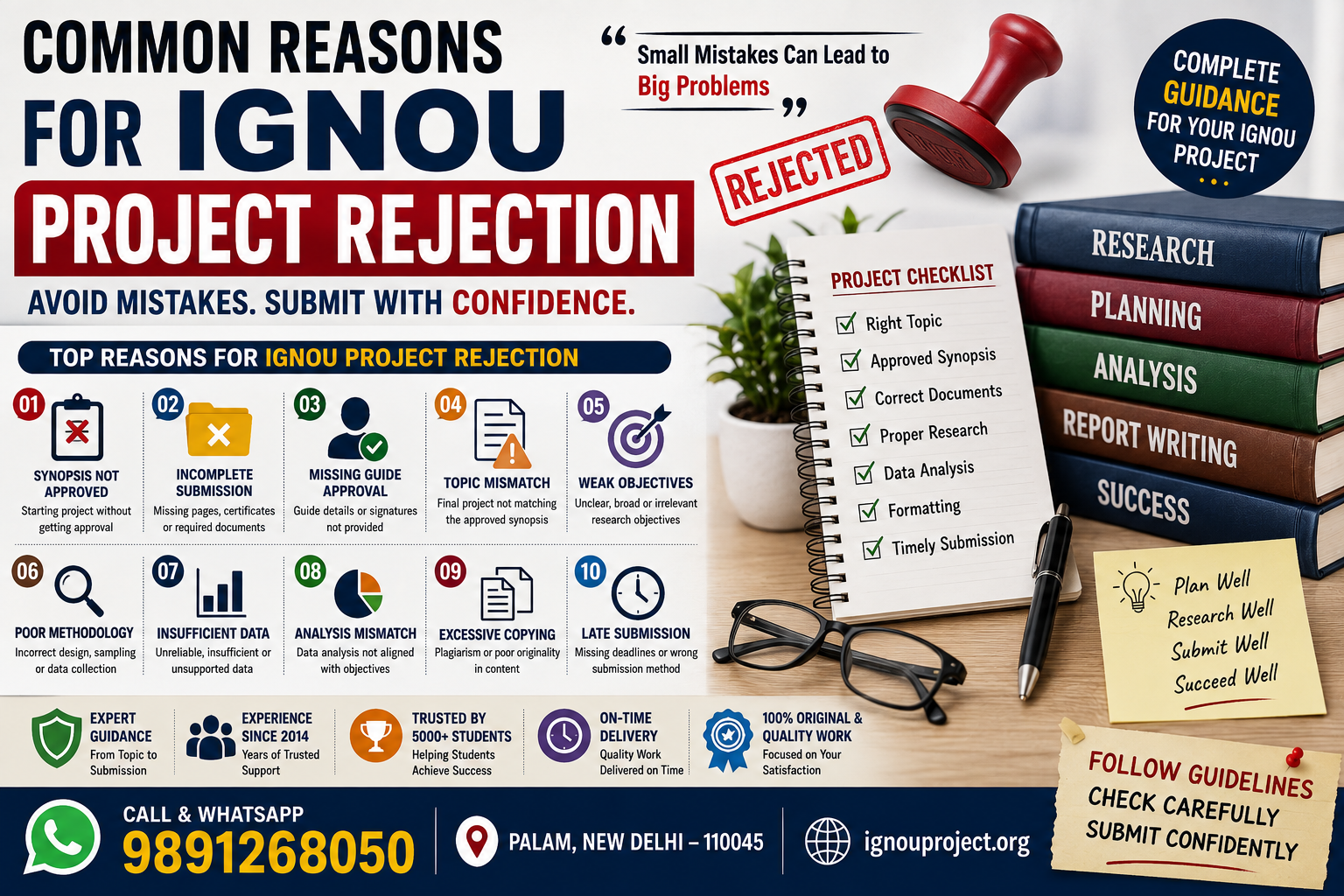
Common Reasons for IGNOU Project Rejection: 15 Mistakes Students Must Avoid
You have spent weeks preparing your IGNOU Project, collected data, prepared chapters and finally completed the report. But what if the project is not considered for evaluation because of a mistake that could have been avoided?
This is where many IGNOU students become worried. A project may look complete from the outside, yet important requirements can still be missing. For example, the synopsis may not have the required approval, documents may be incomplete, the project may not follow the approved topic, or the final PDF may have technical problems.
Therefore, understanding the common reasons for IGNOU Project Rejection is extremely important before submission.
In this guide, we explain the major mistakes in simple language. You will also find practical examples and a final IGNOU Project Submission Checklist that you can use before submitting your project.
Need help checking your IGNOU Project?
Call / WhatsApp: 9891268050
Location: Palam, New Delhi – 110045
Website: ignouproject.org
🔴 First Understand: Why Can an IGNOU Project Be Rejected or Not Considered?
Students often use the word “rejection” for every project problem. However, different situations can occur.
A project proposal can be not approved. A final report can also be not considered for evaluation if required conditions are not fulfilled. In some cases, the student may receive comments and have to revise or resubmit the proposal.
IGNOU’s project instructions state that incomplete submissions will not be considered for evaluation. They also state that a project report not found in order according to the applicable project guidelines may not be considered, with responsibility placed on the learner.
So, don’t wait until after submission to discover a problem.
The safest approach is simple:
Check the topic → Check approval → Check documents → Check report → Check PDF → Check submission process.
Now let’s understand each important mistake.
🚨 1. Starting the Project Without Required Synopsis Approval
This is one of the most important issues students need to understand.
For project courses where prior synopsis or proposal approval is required, students should not assume that completing the report is enough. The applicable project guidelines must be followed before starting the final research work.
For example, IGNOU’s MMPP-001 project information clearly states that synopsis approval is necessary before the project work can actually be taken up.
What can go wrong?
Imagine that you prepare a 60-page project after spending several weeks on it. Later, you discover that the required synopsis approval was never obtained.
That can create a serious problem.
What should you do?
Before starting the final report, check your specific programme’s project guidelines. Confirm whether you need:
- Project proposal
- Synopsis
- Guide approval
- Proposal proforma
- Guide’s bio-data
- School or Regional Centre approval
Requirements differ between programmes. Therefore, never copy the process of another IGNOU course.
📄 2. Incomplete Project Submission
This is one of the clearest reasons mentioned in IGNOU’s online project instructions.
IGNOU states that incomplete submission of the Project Report will not be considered for evaluation. It also states that incomplete submissions may be removed after the last date.
An incomplete submission does not necessarily mean that your research is bad.
It may simply mean that something required is missing.
For example:
- Missing pages
- Missing certificate
- Missing declaration
- Missing synopsis
- Missing approved proposal, where applicable
- Missing guide documents
- Missing required supporting documents
- Incorrect PDF
- Incomplete scanned report
Therefore, don’t check only the number of pages. Check the entire submission package.
✍️ 3. Incorrect or Missing Guide/Supervisor Approval
Many project courses require involvement of an approved guide or supervisor.
Students sometimes prepare a report first and think about the guide documents later. However, the applicable project guidelines may require specific approval forms, signatures or guide details.
IGNOU’s online project instructions specifically mention the approved proposal proforma, synopsis, guide bio-data and originality certificate wherever applicable.
Why is this important?
The guide is not merely a name on the certificate page. In many project structures, the guide plays a role in approving or supervising the research.
Therefore, check:
Guide name → Qualification → Bio-data → Signature → Approval proforma → Certificate
Do not assume that one generic certificate works for every programme.
🎯 4. Final Project Topic Does Not Match the Approved Synopsis
This mistake is particularly important.
Suppose your approved synopsis is:
“Impact of Digital Marketing on Consumer Buying Behaviour.”
But your final report becomes:
“Role of Social Media Influencers in Online Shopping.”
Both topics may be related to marketing. However, they are not necessarily the same research study.
The problem becomes larger if the objectives, methodology and questionnaire also change.
Some IGNOU project guidelines explicitly require the project title to remain consistent with the approved proposal.
Therefore, after synopsis approval, students should not casually change:
- Project title
- Research problem
- Major objectives
- Study area
- Research methodology
If a change is necessary, check the applicable procedure first.
🎓 5. Choosing a Topic That Is Too Broad
A project topic can sound impressive but still be difficult to research.
For example:
“Impact of Tourism on India”
This is extremely broad.
Now compare it with:
“Impact of Heritage Tourism on Local Employment in Selected Areas of Delhi.”
The second topic is easier to research because the researcher has a defined:
Subject + Location + Problem + Target area
Similarly:
“Human Values in Education”
can become:
“Impact of Value Education on Ethical Behaviour Among Undergraduate Students in Selected Colleges of Delhi.”
A focused topic makes the objectives, questionnaire and data analysis much easier.
❌ 6. Weak or Unclear Research Objectives
Your project objectives tell the evaluator what you actually intended to study.
If your title is about employee satisfaction, but your objectives focus mainly on company profits, the project loses consistency.
A strong project should have a clear connection:
Title → Problem → Objectives → Questionnaire → Analysis → Findings → Conclusion
For example, if your objective is:
“To examine the effect of workplace ethics on employee satisfaction,”
your questionnaire should contain questions related to both workplace ethics and employee satisfaction.
Therefore, don’t write objectives simply to increase the number of pages.
🔬 7. Poor Research Methodology
A project should explain how the research was conducted.
Many students write a methodology chapter containing standard terms such as:
“Descriptive research design was used.”
But they do not explain what they actually did.
A proper methodology should normally explain the relevant aspects of:
- Research design
- Study area
- Population
- Sample size
- Sampling method
- Data sources
- Research tools
- Data-collection procedure
- Data-analysis techniques
- Limitations
The exact requirements depend on the programme.
For example, a project based on 100 questionnaire responses should clearly explain who the respondents were, how they were selected and why that sample was appropriate.
📊 8. Data, Tables and Findings Do Not Match
This is a common academic weakness.
Suppose your methodology says that you surveyed 100 respondents.
Then your analysis should consistently reflect the same study.
If one table suddenly shows 150 respondents, another shows 80 and the conclusion discusses 200 respondents, the report becomes inconsistent.
The same applies to percentages.
If 60 out of 100 respondents selected an option, the percentage should be 60%.
Therefore, check every:
Number → Percentage → Table → Chart → Interpretation
before finalising your report.
⚠️ 9. Unsupported or Unreliable Data
A dissertation should be based on genuine research material.
Students sometimes face pressure to complete the project quickly. As a result, they may use random internet information or unsupported numbers.
That can seriously weaken the academic credibility of the project.
If you claim that you conducted a survey, you should be able to explain:
- Who participated?
- How many respondents participated?
- How were they selected?
- What questions were asked?
- How were the responses analysed?
The same principle applies to secondary data.
Use reliable books, research papers, government publications and recognised institutional sources whenever appropriate.
📚 10. Poor Literature Review
A literature review is not simply a collection of copied paragraphs.
Its purpose is to show what previous researchers have already studied and how your research relates to that work.
A useful literature review can answer:
What has already been researched?
What did previous researchers find?
What remains unexplored?
How is my project different or useful?
Therefore, don’t use the literature review merely to increase the word count.
📝 11. Excessive Copying and Poor Academic Originality
Students should understand the difference between using sources and copying sources.
Using a research paper as a reference is perfectly different from copying several paragraphs without proper acknowledgement.
IGNOU’s online project instructions require an originality certificate wherever applicable.
Therefore:
Read → Understand → Analyse → Write in your own academic language → Cite the source.
This approach makes the project more credible.
📑 12. Missing Certificate, Declaration or Required Documents
The final project may require several preliminary pages.
Depending on the programme, these may include:
- Certificate
- Declaration
- Acknowledgement
- Synopsis
- Approved proposal
- Guide details
- Originality certificate
- Questionnaire
- Other prescribed documents
However, not every programme requires exactly the same documents.
Therefore, students should use the format prescribed for their own programme, rather than downloading a random project format from the internet.
🔢 13. Incorrect Student or Course Details
This looks like a small mistake.
It isn’t.
IGNOU’s online project instructions require correct particulars on the first page, including the project title, learner name, programme code, enrolment number, Regional Centre code, course code and contact details.
Before submission, check:
Name
Enrolment Number
Programme Code
Course Code
Regional Centre Code
Project Title
A single incorrect digit in the enrolment number can create unnecessary complications.
So, compare these details directly with your IGNOU records before submitting.
🖨️ 14. Blurred, Dark or Poorly Scanned PDF
This is especially important for online submissions.
Your project may be academically good. However, if the uploaded PDF is difficult to read, you can still face a submission problem.
IGNOU’s online instructions specifically tell learners to ensure that scanned pages are clear, not blurred, properly sequenced, well lit and correctly oriented.
Before uploading, open the final PDF yourself.
Zoom into:
- Certificates
- Tables
- Graphs
- Signatures
- Questionnaires
- References
- Photographs
If something is difficult for you to read, it may also be difficult for the evaluator to read.
📂 15. Incorrect PDF or Submission Format
For online submission, IGNOU’s instructions state that the original project report should be scanned into a single PDF file for one subject/course, where applicable.
Therefore, don’t randomly upload:
Chapter 1.pdf
Chapter 2.pdf
Chapter 3.pdf
unless your specific submission instructions explicitly permit that format.
Instead, follow the current instructions for your particular project.
Also check the final file from beginning to end before clicking Submit.
💰 16. Ignoring the Applicable Project Evaluation Fee
Students sometimes concentrate so much on the report that they forget the administrative requirements.
IGNOU’s project instructions state that the applicable project evaluation fee must be paid according to the prescribed rules. The instructions currently specify ₹300 for projects up to 4 credits and ₹500 for projects above 4 credits for the applicable admission cycle, with the fee submitted along with the TEE form.
However, students should always verify the fee applicable to their own admission cycle and project.
Do not rely on an old screenshot or another student’s payment details.
⏰ 17. Missing the Submission Deadline
A student may have a perfect project but still face problems by missing the applicable submission window.
IGNOU publishes submission instructions and deadlines for different project cycles. Therefore, students should check the latest official notice rather than relying on information from previous years.
Keep a personal deadline earlier than the official deadline.
For example:
Official deadline → Your personal deadline → Final checking → Submission
This gives you some time to fix unexpected problems.
📧 18. Sending the Project Through the Wrong Method
Another mistake is assuming that email submission is acceptable for every project.
IGNOU’s online project instructions specifically state that reports received through email cannot be considered through that submission process.
Therefore, students should first identify the correct submission method for their programme and session.
It may involve an online portal, Regional Centre or another prescribed process.
Never follow a submission method only because another student used it.
🧩 19. Copying the Format of Another IGNOU Programme
This happens more often than students realise.
A student finds an old project online and copies its:
- Certificate
- Cover page
- Synopsis format
- Guide format
- Chapter structure
- Submission process
But the other project may belong to a completely different programme.
For example, the project requirements for an MBA course may differ from those for MCom, MSW, MCA, MA or another programme.
Therefore, always start with the course code and programme-specific guidelines.
🗣️ 20. Not Understanding Your Own Project
This is not always a direct reason for rejection. However, it can become a major problem during evaluation or viva.
Imagine the evaluator asks:
“Why did you select this topic?”
You should be able to answer.
Then they ask:
“What was your sample size?”
You should know.
Then:
“What was your main finding?”
Again, you should know.
Therefore, don’t treat the project as a document that only needs to be submitted.
Read your own project before the viva.
Understand the title, objectives, methodology, sample, findings, limitations and recommendations.
✅ IGNOU PROJECT REJECTION CHECKLIST
Before submitting your project, take 10 minutes and check the following.
Topic & Approval
☐ Is the topic appropriate for your course?
☐ Is the synopsis approved wherever required?
☐ Does the final title match the approved proposal?
☐ Are the guide/supervisor details correct?
Project Content
☐ Is the research problem clearly explained?
☐ Are the objectives specific?
☐ Does the methodology match the objectives?
☐ Is the data genuine and properly explained?
☐ Do tables and percentages match?
☐ Do findings answer the objectives?
☐ Does the conclusion follow from the findings?
Documents
☐ Certificate included where required?
☐ Declaration included where required?
☐ Originality certificate included where required?
☐ Synopsis/proposal included where required?
☐ Guide documents included where required?
Student Details
☐ Name correct?
☐ Enrolment number correct?
☐ Programme code correct?
☐ Course code correct?
☐ Regional Centre details correct?
PDF & Submission
☐ All pages included?
☐ Pages are readable?
☐ No blurred scans?
☐ Correct page sequence?
☐ Correct orientation?
☐ Correct PDF format?
☐ Correct submission portal/method?
☐ Applicable project fee paid?
☐ Current deadline checked?
If you can answer YES to all applicable points, your project is much better prepared for submission.
🔎 What Should You Do If Your Project Has Already Been Rejected?
Don’t panic.
First, identify why the project was not approved or considered.
If you received comments or observations, read them carefully. A proposal may sometimes require reformulation rather than starting the entire project from zero.
For example, some IGNOU project guidelines provide for resubmission of a revised proposal when the original proposal is not approved. The student may receive suggestions for reformulating the project.
Therefore, don’t immediately prepare an entirely new project.
First determine:
Was the topic rejected?
Was the synopsis incomplete?
Was the guide not acceptable?
Was a required document missing?
Was the final report incomplete?
Was the submission procedure incorrect?
Once you know the actual problem, the next step becomes much clearer.
⭐ WHY CHOOSE US FOR IGNOU PROJECT GUIDANCE?
Preparing an IGNOU project can become stressful when you are unsure whether everything is correct.
We provide student-friendly project guidance from topic selection to final checking.
🎯 Approval-Focused Review
We review the major components of your project, including the topic, objectives, methodology, documentation and formatting.
The goal is simple: identify avoidable mistakes before submission.
Final approval always remains with IGNOU, the concerned supervisor and the evaluator. Therefore, no independent service can honestly guarantee approval.
🕐 Experience Since 2014
We have been helping IGNOU students with project guidance since 2014.
Over the years, we have worked with students from different programmes and helped them understand the project process more clearly.
👨🎓 Trusted by More Than 5,000 Students
More than 5,000 students have received assistance with different stages of their IGNOU projects.
Our focus is not simply on preparing a report. We also help students understand the structure, research process and submission requirements.
🚚 On-Time Delivery
Project deadlines matter.
Therefore, we plan the synopsis, project report, revisions and final formatting according to the student’s timeline.
Early contact is always better because it leaves time for corrections and approval-related requirements.
🛠️ Complete Project Support
Depending on your requirement, guidance can include:
- Topic selection
- Synopsis preparation
- Research objectives
- Research methodology
- Questionnaire preparation
- Data-analysis guidance
- Chapter-wise project support
- Editing and proofreading
- Formatting
- Correction support
- Viva preparation
- Final submission checklist
📞 CHECK YOUR IGNOU PROJECT BEFORE SUBMISSION
Are you unsure whether your IGNOU Project is ready for submission?
Don’t wait until after submission to discover a missing document, incorrect course code, topic mismatch or PDF problem.
You can contact us for project review, synopsis guidance, topic selection, methodology support, formatting and submission-related guidance.
📱 Call / WhatsApp: 9891268050
📍 Location: Palam, New Delhi – 110045
🌐 Website: ignouproject.org
Before you submit, check. Before you panic, verify. Before you start again, find the actual reason.
⚖️ IMPORTANT DISCLAIMER
We are an independent academic-support provider. We are not an official IGNOU department, Study Centre or authorised representative of IGNOU.
Project requirements can vary according to the programme, course code, admission session and applicable IGNOU guidelines. Therefore, students should always verify the latest official instructions before submission.
Final project approval and evaluation remain the responsibility of IGNOU and the concerned academic authorities.
❓ FREQUENTLY ASKED QUESTIONS
Can IGNOU reject a project because the synopsis was not approved?
Where prior synopsis approval is required, students should obtain the required approval before undertaking the final project. The exact process depends on the programme.
What happens if the project submission is incomplete?
IGNOU states that incomplete project submissions will not be considered for evaluation.
Can I change my topic after synopsis approval?
Do not make major changes without checking your programme’s applicable project guidelines. Some project guidelines require consistency between the approved proposal and final project.
Can a wrong enrolment number cause a problem?
Yes. Students should carefully verify the enrolment number and other learner details before submission. IGNOU specifically requires correct learner particulars on the project’s first page for online submission.
Can a blurry PDF cause a problem?
Yes. IGNOU’s instructions require clear, readable scans with correct sequence and orientation.
Can I submit my project by email?
Students should not assume that email submission is valid. IGNOU’s online project instructions state that reports received through email cannot be considered through that submission process.
Can an old project format be used?
It is better to follow the current guidelines applicable to your own programme and session. Requirements can differ between courses.
What should I do if my project proposal is not approved?
First read the evaluator’s comments or instructions. Where the programme provides a resubmission process, revise the proposal according to the specified observations and submit it through the prescribed method.
Can you check my existing IGNOU project?
Yes. You can contact us for guidance on topic, synopsis, objectives, methodology, formatting, documentation and common submission mistakes.
🔗 OFFICIAL IGNOU PROJECT INFORMATION
For the latest project submission instructions, always verify the information directly from IGNOU.
IGNOU Official Project Submission Instructions
For programme-specific requirements, students should also check the relevant programme page and project manual on the official IGNOU website.
📌 FINAL WORD
The biggest mistake students make is assuming that “my project is complete, so it is ready for submission.”
A project is ready only when the topic, approval, research, documents, formatting and submission process are all checked.
Therefore, take a final pause before uploading.
Open your project.
Check every page.
Verify your enrolment number.
Check the course code.
Confirm the required approvals.
Review your PDF.
Then submit.
A few minutes of careful checking can save you from weeks of unnecessary stress.