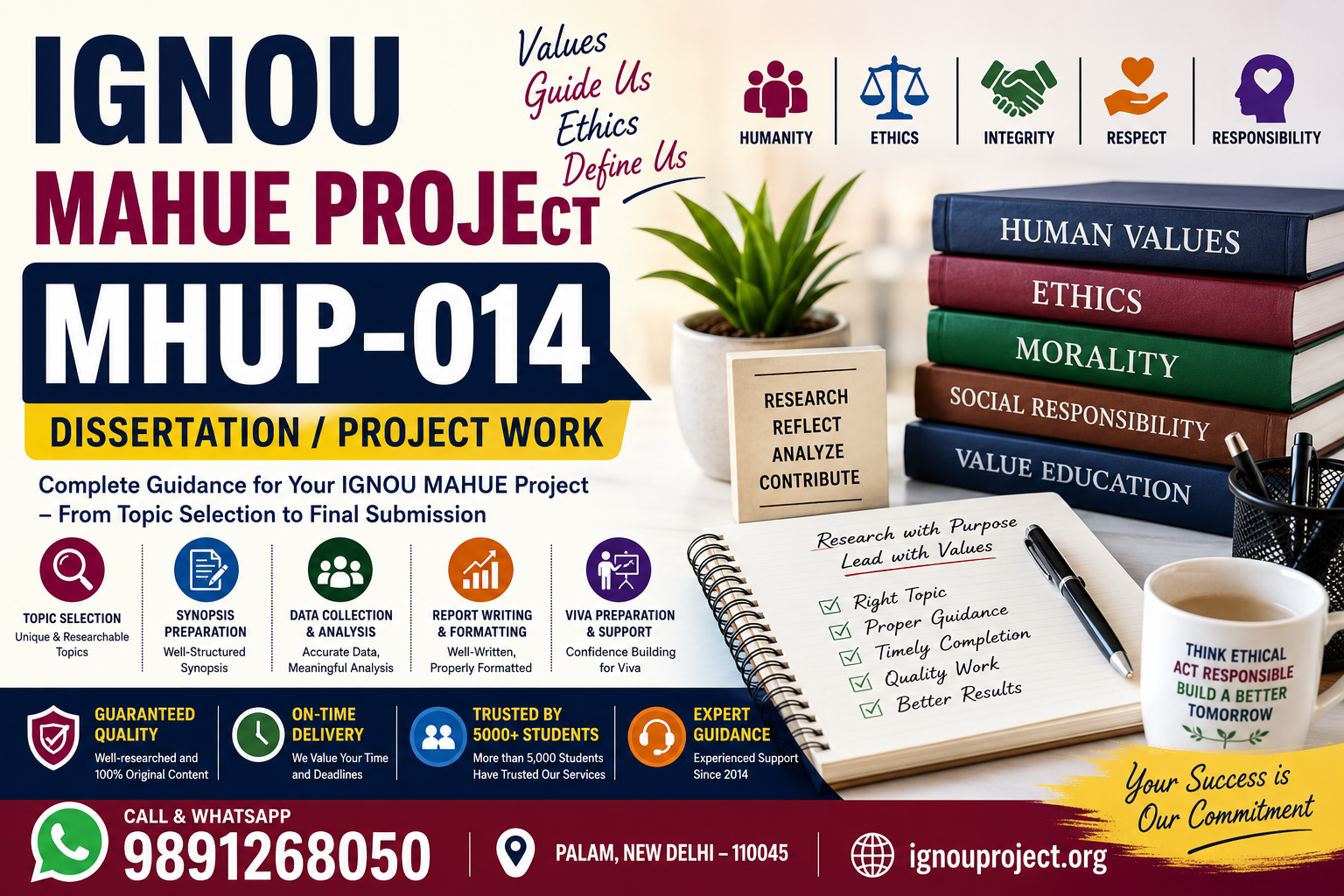
✨ IGNOU MAHUE PROJECT MHUP-014: TOPICS AND GUIDANCE ✨
Are you pursuing the Master of Arts in Human Values and Ethics, also known as MAHUE, and finding your IGNOU MAHUE Project MHUP-014 difficult? You are not alone. Many students face problems while selecting a suitable topic, preparing the synopsis, choosing the correct research methodology and writing the final project report.
The IGNOU MAHUE Project MHUP-014 gives students an opportunity to study an important ethical, social or professional issue. Moreover, it helps learners connect theoretical concepts of human values and ethics with real-life situations.
Students can conduct research on human values in education, governance, business, healthcare, media, technology, environmental protection and professional life. However, a successful project requires a focused topic, clear objectives, suitable research methods and proper academic presentation.
For complete guidance related to the IGNOU MAHUE Project MHUP-014, contact us:
Call and WhatsApp: 9891268050
Location: Palam, New Delhi – 110045
Website: ignouproject.org
📘 IGNOU MAHUE PROJECT MHUP-014 – COURSE OVERVIEW
The Master of Arts in Human Values and Ethics is a postgraduate programme that develops an understanding of moral values, ethical decision-making and responsible social behaviour.
The programme examines the role of ethics in personal life, education, governance, business, media, healthcare and other professional fields. Therefore, students develop both theoretical understanding and practical awareness of ethical concerns.
MHUP-014 is the dissertation or project component of the MAHUE programme. Through this project, students conduct an organised study on a selected issue related to human values and ethics.
The project generally requires learners to:
- Select a focused research topic
- Identify a clear research problem
- Prepare appropriate objectives
- Review relevant literature
- Select a suitable research methodology
- Collect primary or secondary data
- Analyse and interpret the information
- Present findings and recommendations
- Prepare the final dissertation in an academic format
Students should always check the latest project instructions provided by IGNOU, their Study Centre and their approved project supervisor.
🎯 WHY THE IGNOU MAHUE PROJECT MHUP-014 MATTERS
The IGNOU MAHUE Project MHUP-014 is more than a general essay on morality or values. It is an organised research activity that requires the student to investigate an ethical or social issue systematically.
Human values influence individual behaviour, family relationships, professional conduct and institutional decision-making. For example, honesty strengthens public administration, while empathy improves healthcare and social services. Similarly, environmental responsibility encourages sustainable development.
The project helps students understand the difference between ethical ideals and actual practices. Therefore, learners can study how values function in real educational institutions, organisations, communities and professional environments.
Through the project, students develop important skills such as:
- Identification of ethical and social problems
- Development of measurable research objectives
- Preparation of questionnaires and interviews
- Collection of reliable information
- Analysis of attitudes and perceptions
- Academic writing and referencing
- Development of evidence-based conclusions
- Preparation for evaluation or viva
Consequently, the project can strengthen both academic knowledge and professional awareness.
💡 20 IGNOU MAHUE PROJECT TOPICS FOR MHUP-014
Choosing the right topic is the first major step in the project process. A suitable topic should be relevant, focused and practically researchable.
The following are 20 suggested topics for the IGNOU MAHUE Project MHUP-014:
- Role of Human Values in Promoting Ethical Leadership
- Impact of Value Education on the Behaviour of College Students
- Ethical Challenges in the Use of Artificial Intelligence
- Human Values and Professional Ethics Among School Teachers
- Role of Ethics in Good Governance and Public Administration
- Impact of Social Media on Human Values Among Young Adults
- Environmental Ethics and Sustainable Lifestyle Practices
- Ethical Issues in Corporate Social Responsibility
- Human Values and Employee Satisfaction in the Workplace
- Role of Moral Education in Character Development
- Ethical Challenges Faced by Healthcare Professionals
- Gender Equality as a Human and Ethical Value
- Consumer Awareness of Ethical Business Practices
- Role of Empathy and Compassion in Social Work
- Academic Integrity and Ethical Behaviour Among University Students
- Ethical Issues in Digital Privacy and Data Protection
- Human Values in Indian Philosophical Traditions
- Role of Media Ethics in Responsible Journalism
- Cross-Cultural Differences in Ethical Decision-Making
- Impact of Value-Based Leadership on Organisational Culture
These topics are only suggestions. Students can customise them according to their interests, location, profession and availability of data.
📚 ADDITIONAL RESEARCH AREAS FOR MHUP-014
Students can select topics from several fields of human values and applied ethics. Therefore, they should choose an area that matches their academic interest or professional background.
Human Values in Education
Students may study value education, moral development, academic integrity, teacher ethics and student behaviour. Moreover, they can examine how educational institutions promote honesty, respect, discipline and responsibility.
Ethics in Leadership and Governance
Possible research areas include transparency, accountability, corruption, ethical leadership, public service values and responsible decision-making.
Business Ethics and Corporate Responsibility
Students can examine fair trade, ethical marketing, employee welfare, corporate governance and corporate social responsibility.
Media and Digital Ethics
Research topics may include fake news, digital privacy, cyberbullying, online behaviour, artificial intelligence and responsible journalism.
Environmental Ethics
Students may study climate responsibility, sustainable consumption, waste management, animal ethics and environmental justice.
Professional Ethics
This area includes ethical conduct in healthcare, education, law, management, social work, research and public administration.
Gender and Social Justice
Students may examine gender equality, discrimination, human dignity, inclusion and ethical attitudes towards marginalised groups.
🔍 HOW TO SELECT THE BEST MHUP-014 PROJECT TOPIC
A broad topic often creates difficulties during research. Therefore, students should narrow their subject by selecting a specific group, institution, location or ethical issue.
For example:
Broad topic: Human Values in Education
Focused topic: Impact of Value Education on Undergraduate Students in Selected Colleges of Delhi
Another example is:
Broad topic: Business Ethics
Focused topic: Consumer Awareness of Ethical Marketing Practices Among Online Shoppers in New Delhi
A suitable topic should meet the following conditions:
- It should relate directly to human values or ethics.
- The research problem should be clear.
- The study population should be accessible.
- The objectives should be specific and measurable.
- Reliable data should be available.
- The project should be manageable within the available time.
- The subject should have academic and social relevance.
- The student should be able to explain it confidently.
Most importantly, students should not select a topic only because it sounds impressive. Instead, they should choose a topic that can be researched properly.
📍 SAMPLE LOCATION-BASED PROJECT TITLES
Students living in Delhi or nearby areas can consider the following focused project titles:
- A Study of Academic Integrity Among College Students in Delhi
- Human Values and Workplace Behaviour Among Private-Sector Employees in New Delhi
- Ethical Awareness Among Healthcare Workers in Selected Delhi Hospitals
- Impact of Social Media on Human Values Among College Students in Palam
- Consumer Awareness of Ethical Business Practices in New Delhi
- Role of Value Education in Selected Schools of Delhi
- Environmental Ethics Among Urban Households in Palam
- Ethical Leadership and Employee Motivation in Selected Organisations
- Awareness of Digital Privacy Among University Students in Delhi
- Gender Equality and Ethical Attitudes Among Young Adults
These titles can be modified according to the study area, available respondents and selected objectives.
📝 IGNOU MAHUE PROJECT SYNOPSIS FOR MHUP-014
The project synopsis presents the basic plan of the proposed research. It explains what the student wants to study, why the topic is important and how the research will be conducted.
A well-prepared synopsis should maintain consistency between the project title, objectives, methodology and proposed data analysis.
The synopsis may contain the following sections.
Proposed Title
The title should clearly state the ethical issue, target group and study area. It should remain concise and specific.
Introduction
The introduction explains the background of the selected topic. Moreover, it establishes its connection with human values and ethics.
Statement of the Problem
This section identifies the exact issue that the project intends to examine. It should avoid vague or general statements.
Rationale of the Study
The rationale explains why the study is necessary. For example, it may highlight an ethical dilemma, social concern or gap in previous research.
Review of Literature
The literature review discusses relevant books, journal articles, reports and previous studies. However, students should not simply list the sources. They should explain how earlier research relates to the present study.
Objectives of the Study
The objectives should clearly state what the researcher intends to investigate. Usually, four to six objectives are suitable for a student project.
Research Questions or Hypotheses
Research questions guide the study. Alternatively, hypotheses may be formulated where statistical testing is required.
Research Methodology
The methodology may explain:
- Research design
- Study area
- Target population
- Sample size
- Sampling method
- Sources of data
- Data-collection tools
- Methods of analysis
- Ethical considerations
- Limitations of the study
Proposed Chapter Scheme
The synopsis may provide a tentative chapter-wise outline of the final dissertation.
References
All sources used during synopsis preparation should be mentioned in a consistent citation style.
🎯 SAMPLE OBJECTIVES FOR AN MHUP-014 PROJECT
Suppose the selected project title is:
“Impact of Social Media on Human Values Among College Students in Delhi.”
The research objectives may be:
- To examine the social media usage patterns of college students.
- To study the influence of social media on honesty, empathy and respect.
- To analyse students’ awareness of responsible online behaviour.
- To identify common ethical problems experienced on social media.
- To suggest measures for promoting ethical digital practices.
The questionnaire should be directly connected with these objectives. Consequently, the data analysis and findings will remain focused.
🔬 RESEARCH METHODOLOGY FOR THE MHUP-014 PROJECT
Research methodology explains how the study will be conducted. Therefore, students should select methods that match the project topic and objectives.
Research Design
The study may use a descriptive, exploratory, analytical, comparative or case-study design.
A descriptive research design is commonly used when the project examines attitudes, awareness, opinions or perceptions.
Primary Data
Primary data is collected directly from respondents. Depending on the topic, respondents may include:
- Students
- Teachers
- Employees
- Managers
- Healthcare professionals
- Consumers
- Social workers
- Media professionals
- Community members
- Government employees
Primary data may be collected through questionnaires, interviews, observation or focus-group discussions.
Secondary Data
Secondary data may be obtained from books, journals, research papers, government reports and institutional publications.
Students should use reliable and relevant sources. Furthermore, they should avoid depending on unverified websites.
Sampling
The researcher may use:
- Simple random sampling
- Convenience sampling
- Purposive sampling
- Stratified sampling
- Snowball sampling
The selected method should be justified according to the nature of the study.
Data Analysis
The collected information may be analysed through:
- Frequency distributions
- Percentages
- Mean scores
- Ranking methods
- Comparative analysis
- Cross-tabulation
- Correlation
- Thematic analysis
Tables and charts can improve clarity. Nevertheless, every table should include a proper explanation.
📑 SUGGESTED MHUP-014 DISSERTATION STRUCTURE
A properly organised structure improves the academic quality and readability of the final report.
Preliminary Pages
The preliminary section may include:
- Title page
- Certificate
- Student declaration
- Acknowledgement
- Table of contents
- List of tables
- List of figures
- List of abbreviations
Chapter 1: Introduction
This chapter may contain:
- Background of the study
- Statement of the problem
- Rationale of the study
- Research objectives
- Research questions
- Scope of the study
- Limitations of the study
Chapter 2: Review of Literature
The literature-review chapter discusses relevant theories and previous studies. Furthermore, it identifies the gap addressed by the present project.
Chapter 3: Research Methodology
This chapter explains the research design, sample size, sampling method, data sources, tools and analytical techniques.
Chapter 4: Profile of the Study Area
This chapter describes the selected institution, organisation, community, profession or geographical area.
Chapter 5: Data Analysis and Interpretation
The collected data is presented through tables, charts, percentages or themes. Each result should relate directly to a research objective.
Chapter 6: Findings and Discussion
This chapter summarises the main findings. It also discusses them in relation to previous research and relevant ethical concepts.
Chapter 7: Conclusion and Suggestions
The final chapter presents conclusions, recommendations, limitations and possibilities for future research.
Bibliography and Appendices
The report should include a complete bibliography. Appendices may contain questionnaires, consent forms, photographs and additional tables.
⚠️ COMMON PROBLEMS FACED BY MAHUE STUDENTS
Preparing the IGNOU MAHUE Project MHUP-014 requires academic planning and research skills. However, many students also manage employment, family responsibilities and other academic work.
Common difficulties include:
- Confusion regarding topic selection
- Lack of clarity about synopsis preparation
- Weak research objectives
- Difficulty selecting the sample
- Problems preparing the questionnaire
- Limited access to reliable sources
- Errors in data analysis
- Weak connection between objectives and findings
- Incorrect references
- Poor formatting
- Lack of confidence before the viva
- Difficulty meeting submission deadlines
Proper guidance can make the process more organised. In addition, it can help students avoid common academic and structural errors.
⭐ WHY CHOOSE US FOR IGNOU MAHUE PROJECT MHUP-014?
We provide student-friendly guidance for different stages of the IGNOU MAHUE Project MHUP-014. Our services focus on academic clarity, proper structure and timely completion.
Approval-Focused Quality Review
We carefully review the topic, objectives, research methodology, questionnaire, chapter structure and formatting. Therefore, the project can better align with the applicable academic requirements.
Final approval depends on IGNOU, the approved supervisor and the evaluator. However, our systematic review can reduce avoidable mistakes and correction requirements.
Experience Since 2014
We have been helping IGNOU students with project guidance since 2014. As a result, we understand the common challenges faced by distance-learning students.
Our approach maintains a logical connection between the research problem, objectives, methodology, data, findings and conclusion.
Trusted by More Than 5,000 Students
More than 5,000 students have received assistance with different stages of their IGNOU projects.
Moreover, this experience enables us to provide practical and student-friendly guidance for different programmes and research subjects.
On-Time Delivery
We understand the importance of project deadlines. Therefore, we plan the synopsis, questionnaire, chapters and corrections carefully.
Students should contact us early so that enough time remains for approval, data collection, revision and final formatting.
Personalised Topic Selection
Every student has different interests, resources and professional experience. Consequently, we customise project topics according to the learner’s location, academic background and access to respondents.
Clear and Understandable Content
The project is prepared in clear academic language. Therefore, students can understand their dissertation and explain it confidently during evaluation.
Topic-Specific Project Guidance
Each project is developed according to the selected topic, research objectives and available data. Students should also participate actively in the research process.
🛠️ COMPLETE PROJECT SUPPORT SERVICES
Our guidance for the IGNOU MAHUE Project MHUP-014 includes:
- Topic selection and customisation
- Synopsis and proposal preparation
- Research objectives and questions
- Literature-review guidance
- Research methodology
- Sample-size and sampling guidance
- Questionnaire preparation
- Primary and secondary data guidance
- Tables, charts and data analysis
- Chapter-wise dissertation support
- Findings, conclusions and recommendations
- References and bibliography
- Editing and proofreading
- Formatting and correction support
- Viva preparation
🚀 STEP-BY-STEP PROJECT GUIDANCE PROCESS
Step 1: Contact Us
Share your programme name, course code and preferred research area through call or WhatsApp.
Step 2: Select a Topic
Choose a focused project topic according to your interests and availability of data.
Step 3: Prepare the Synopsis
Develop the introduction, research problem, objectives, literature review and methodology.
Step 4: Complete the Approval Process
Follow the applicable instructions provided by IGNOU, the Study Centre and the approved project supervisor.
Step 5: Collect Data
Use questionnaires, interviews, observations or secondary sources according to the selected methodology.
Step 6: Analyse the Information
Prepare relevant tables, percentages, comparisons or themes.
Step 7: Write the Dissertation
Organise the report chapter by chapter. Moreover, connect every chapter with the research objectives.
Step 8: Review and Format
Check the language, references, tables, page arrangement and academic consistency.
Step 9: Prepare for the Viva
Understand the project title, objectives, methodology, sample, findings and limitations.
👨🎓 WHO CAN CONTACT US?
Our project-guidance services are suitable for:
- Students who need help selecting a project topic
- Learners preparing their first synopsis
- Students whose proposal requires revision
- Learners facing research-methodology problems
- Students requiring questionnaire guidance
- Learners needing data-analysis assistance
- Students requiring editing and formatting
- Working learners facing time constraints
- Students preparing for evaluation or viva
✅ START YOUR MHUP-014 PROJECT WITH CONFIDENCE
The IGNOU MAHUE Project MHUP-014 gives students an opportunity to examine the practical importance of values and ethics.
The project may address important concerns in education, governance, business, healthcare, media, technology and social life.
A successful dissertation requires a focused topic, clear objectives and suitable research methods. In addition, students should analyse information carefully and acknowledge all sources.
With proper guidance and active participation, students can complete their project confidently. They can also develop a deeper understanding of ethical decision-making and responsible behaviour.
📞 CONTACT US TODAY
For assistance with the IGNOU MAHUE Project MHUP-014, contact us for topic selection, synopsis preparation, research methodology, questionnaire, data analysis, dissertation writing and viva guidance.
Call and WhatsApp: 9891268050
Location: Palam, New Delhi – 110045
Website: ignouproject.org
Get personalised and student-friendly guidance for your Master of Arts in Human Values and Ethics Project – MHUP-014.
⚖️ IMPORTANT ACADEMIC DISCLAIMER
We are an independent academic-support provider. We are not an official IGNOU department, Study Centre or authorised representative.
Our services provide research guidance, mentoring, editing and formatting support. Students should participate actively, verify their data and understand the final project report.
Moreover, learners must follow the latest instructions issued by IGNOU, their Regional Centre, Study Centre and approved supervisor.
❓ FREQUENTLY ASKED QUESTIONS
What is MHUP-014?
MHUP-014 is the dissertation or project component of the Master of Arts in Human Values and Ethics programme.
What is the best topic for MHUP-014?
The best topic depends on the student’s interest and availability of data. However, value education, ethical leadership, professional ethics, environmental ethics and media ethics are useful research areas.
Can I get assistance with topic selection?
Yes. Topic-selection guidance is available according to the student’s interests, location and access to respondents.
Do you provide help with synopsis preparation?
Yes. Guidance is available for the title, introduction, problem statement, objectives, literature review, methodology and references.
Can you prepare a questionnaire?
Yes. The questionnaire can be planned according to the project objectives and selected respondents.
Is data-analysis guidance available?
Yes. Guidance is available for percentages, tables, charts, comparisons and interpretation.
Can an existing dissertation be reviewed?
Yes. Existing work can be reviewed for structure, language, methodology, objectives, references and formatting.
Do you provide viva guidance?
Yes. Students can receive guidance for explaining their topic, objectives, methodology, findings and conclusion.
How can I contact you?
Call or WhatsApp us at 9891268050.
Where are you located?
We are located in Palam, New Delhi – 110045.
🔎 SEO DETAILS
Focus Keyphrase
IGNOU MAHUE Project MHUP-014
SEO Title
IGNOU MAHUE Project MHUP-014: Topics and Guidance
Meta Description
Get IGNOU MAHUE Project MHUP-014 guidance for topics, synopsis, methodology, data analysis, dissertation writing and viva support.
Hero Image Alt Text
IGNOU MAHUE Project MHUP-014 topics, synopsis and dissertation guidance
Suggested Image Title
IGNOU MAHUE Project MHUP-014 Guidance
Suggested Image Caption
Get guidance for the IGNOU MAHUE Project MHUP-014, including topic selection, synopsis, research methodology and dissertation support.